Mekong Delta youth pursue ag innovation
Update: May 23, 2026 - 20:25 (GMT+7)


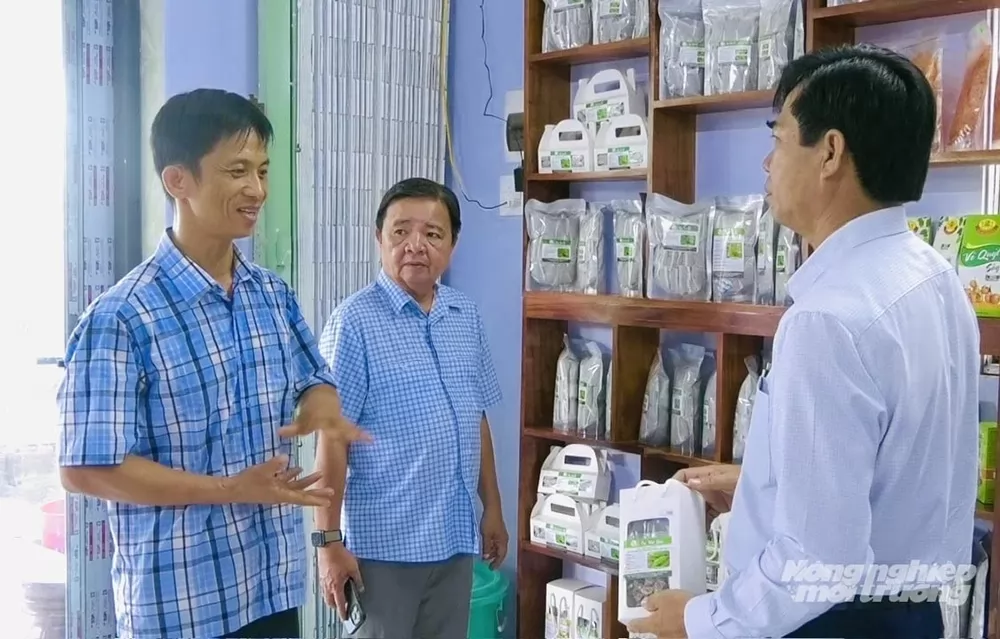
Phan Hoi Huong (Dong Thap) successfully launches a business producing guava leaf tea bags with modern processing and packaging systems and is aiming for OCOP-certified products that meet safety standards. Photo: Le Hoang Vu.
(VAN) Young people across the Mekong Delta are leveraging local advantages to launch high-tech agricultural ventures and build sustainable value chains.
Making use of local resources
In recent years, the wave of young people leaving cities to return home and start agricultural businesses has spread strongly across the Mekong Delta.
Moving beyond fragmented production models, many young entrepreneurs have chosen new directions: integrating agriculture with high technology, applying circular economy principles, transforming crops, and contributing to local agricultural restructuring, thereby building agricultural value chains.
Tam Nong commune is one of the localities in Dong Thap province with many successful startup stories. A notable example is the journey of young entrepreneur Phan Hoi Huong.
Huong was born and raised in the fertile Dong Thap Muoi region of fields, orchards, and fish ponds. After spending some time working as a factory worker for a foreign company in Ho Chi Minh city and accumulating capital, he decided to return home to build a business.
Recognizing the value of familiar plants grown in home gardens, traditional ingredients closely tied to local life, Huong paid special attention to guava leaves, known in folk remedies for treating diarrhea or making herbal steam baths. He then developed the idea of producing guava leaf tea bags to modernize traditional herbal medicine.
In 2022, he began experimenting on more than 1,500 square meters of family garden, learning through books, media, and startup models across the Mekong Delta.
At first, production consisted of only a few dozen tea bags for family use. The guava leaf tea he created had a mild aroma, was easy to drink, and lacked bitterness, so positive feedback quickly came in abundance. This encouraged him to officially establish a production facility and invest in equipment such as freeze-drying systems, grinding machines, and modern packaging devices.
The entire production process has been standardized toward safety. Young guava leaves are carefully selected, dried at low temperatures to preserve medicinal properties, then finely ground and packaged with precise measurements. As a result, the products ensure quality while meeting food safety requirements.
Today, Huong’s guava leaf tea bags have been selected by local authorities for registration as a 3-star OCOP product and enjoy stable consumption both within and outside the province. Each month, the facility sells from several hundred to over 1,000 products, generating stable income and creating jobs for local workers.
Not satisfied with initial success, Huong has expanded into hydroponic pennywort cultivation in membrane houses, combined with clean juice production under the 3F model (Feed – Farm – Food). This represents a typical direction in high-tech agriculture: controlling quality from inputs to final products.
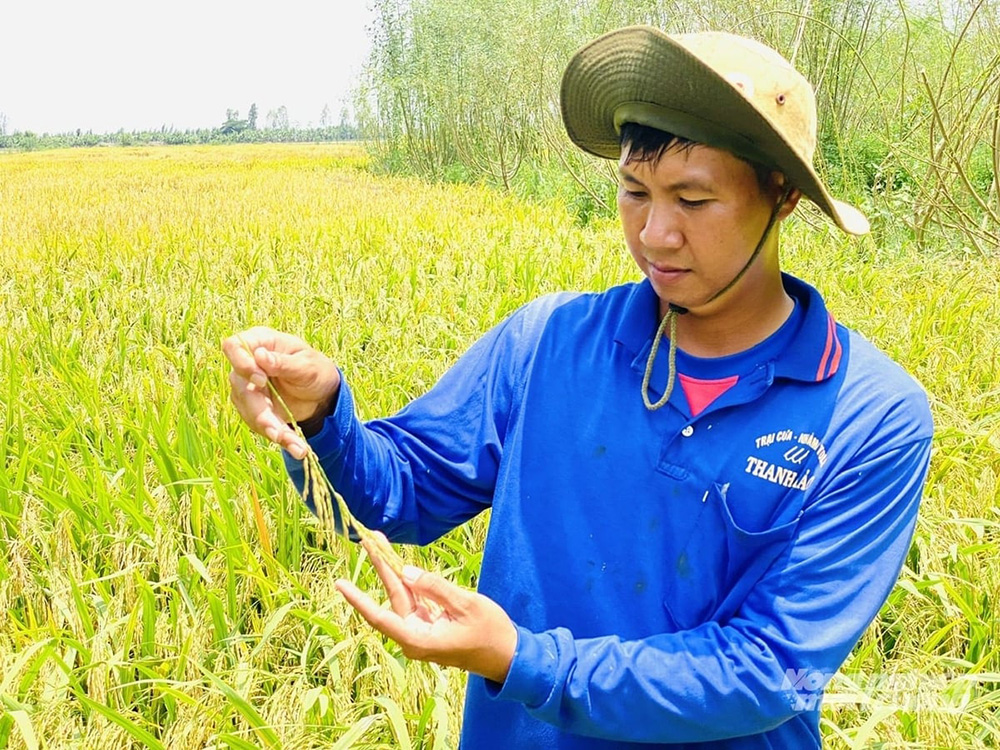
Nguyen Minh Tuan, Director of Quyet Tien Cooperative in Phu Thanh A commune (Dong Thap), inspects rice quality in fields. The model applies circular, low-emission farming practices to increase value. Photo: Le Hoang Vu.
Tran Thanh Nam, Secretary of the Party Committee of Tam Nong commune (Dong Thap), said local leaders are delighted as young people like Huong have dared to dream, take risks, and pursue entrepreneurship in high-tech agriculture with successful outcomes. The commune is considering supporting his access to capital to expand production and markets, particularly through e-commerce platforms.
Another direction increasingly chosen by young people in the Mekong Delta is building agricultural production linkages.
Nguyen Minh Tuan, Director of Quyet Tien Cooperative in Phu Thanh A commune (Dong Thap), has implemented a circular, low-emission rice production model. In just three years, the cultivation area expanded from 20 hectares to 150 hectares, attracting dozens of farming households.
The model applies technical innovations such as sparse sowing, organic fertilizers, reduced pesticide use, and full mechanization. Notably, the use of drones for spraying pesticides and applying fertilizers helps lower costs and reduce environmental impacts.
Another highlight is post-harvest straw treatment. Instead of burning straw and causing pollution, farmers collect it or use microorganisms to decompose it, returning nutrients to the soil. As a result, field ecosystems have significantly improved.
Although yields are lower than those of traditional methods, farmers’ profits still increase by more than 30% thanks to purchase agreements with businesses offering prices above market rates. This is the advantage of value chain production: it reduces risks while increasing product value.
Value chain linkages is the key to sustainable development
Doan Phan Dinh, Director of Boar Services Commercial Production Limited Liability Company in Tan Nhuan Dong commune (Dong Thap), is another young entrepreneur who has found success through linked hybrid wild boar farming with local households.
After graduating from university about ten years ago, Dinh started a small-scale boar farm. Following initial success, he gradually expanded his herd and established a company supplying hybrid wild boars and breeding stock.
To date, Dinh’s company has successfully built a linked farming model focused on “clean production from farm to table.” Beyond providing breeding stock, his company offers technical support, feed, and guaranteed product purchasing for thousands of households.
A distinctive feature of the model is the use of natural feed sources and agricultural by-products, minimizing antibiotics and chemicals. Livestock waste is biologically treated and reused as fertilizer, forming a closed-loop circular system.
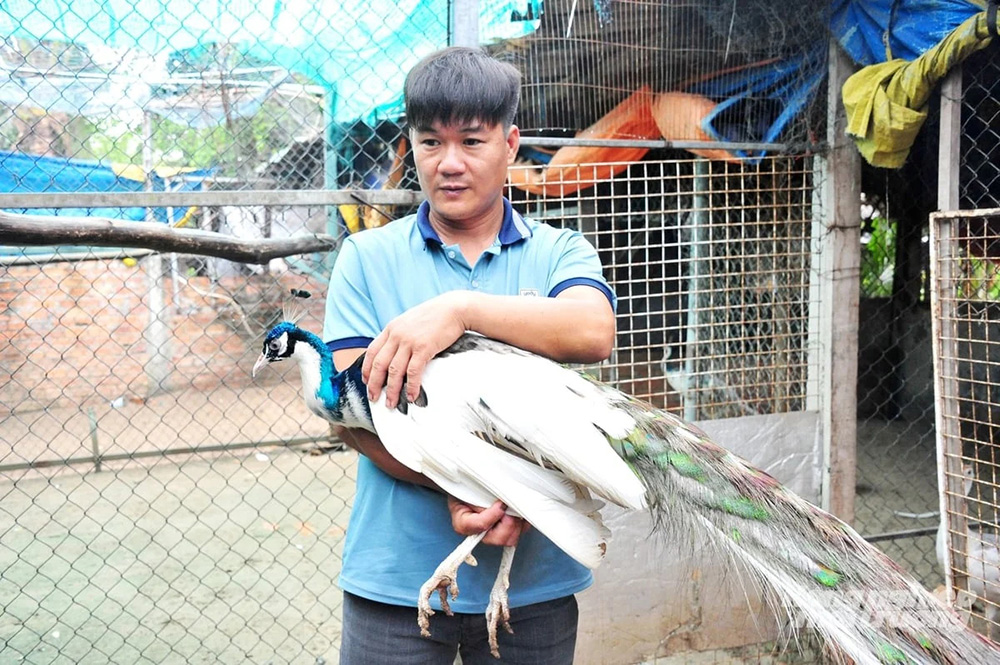
Tran Van Toan, from Thoi An Dong Ward (Can Tho city), combines pork farming with peafowl breeding, creating a unique model with high economic efficiency. Photo: Le Hoang Vu.
Young people of Can Tho is able to find another path, which is production diversification. Tran Van Toan from Thoi An Dong ward is a prime example. He combines pork farming with peafowl breeding, generating high economic returns. On average, his family earns more than VND 350 million annually from the model.
Under this farming system, Toan uses leftover restaurant food to grow vegetables and bananas to supplement feed, significantly reducing livestock costs. Meanwhile, raising peafowl - a species with high economic value - helps increase income and spread the risks.
What these high-tech agricultural startup models in the Mekong Delta share is the combination of new knowledge and traditional experience. Young people are not only producing agricultural goods but also building brands, applying technology, connecting with markets, and aiming for sustainable development.
Authors: Le Hoang Vu – Dao Trung Chanh
Translated by Samuel Pham
Maybe you are interested
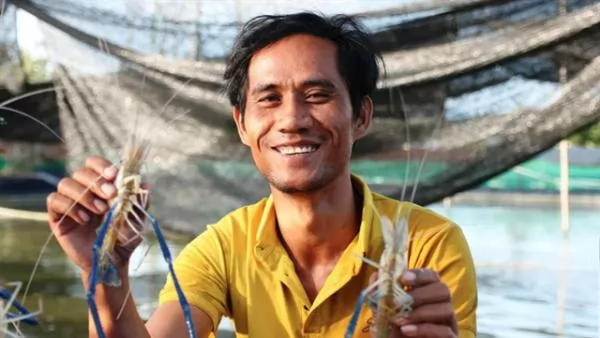
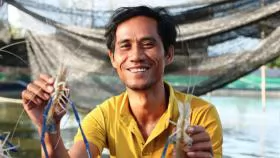
Chăm ethnic farmer raises prawns on arid land
NINH THUẬN — A Chăm ethnic man in the coastal province of Ninh Thuận surprised his friends and neighbours by successfully turning barren, dry land into ponds for breeding giant freshwater prawns.
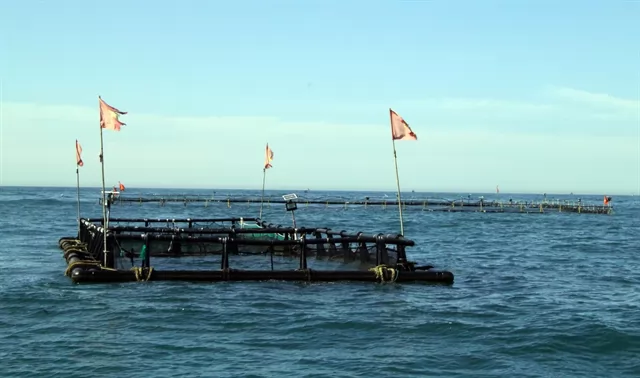
Ninh Thuận farmers expand aquaculture
The province has great potential for developing marine aquaculture as it has a coastline of more than 100km, and clean sea water with high and consistent salinity.
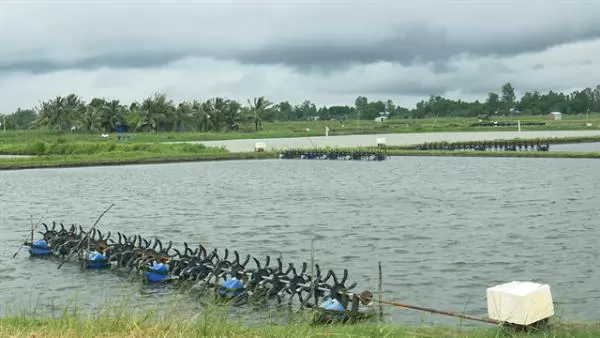
Sóc Trăng develops effective shrimp farming models
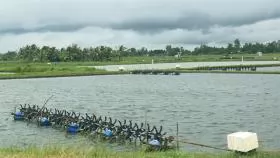
SÓC TRĂNG — Farmers in the Cửu Long (Mekong) Delta province of Sóc Trăng have begun breeding shrimp, and hope for a yield of 196,000 tonnes this year, according to the local Fisheries Sub-department.