Data science improves efficiency in sea area allocation
Update: May 09, 2026 - 13:30 (GMT+7)


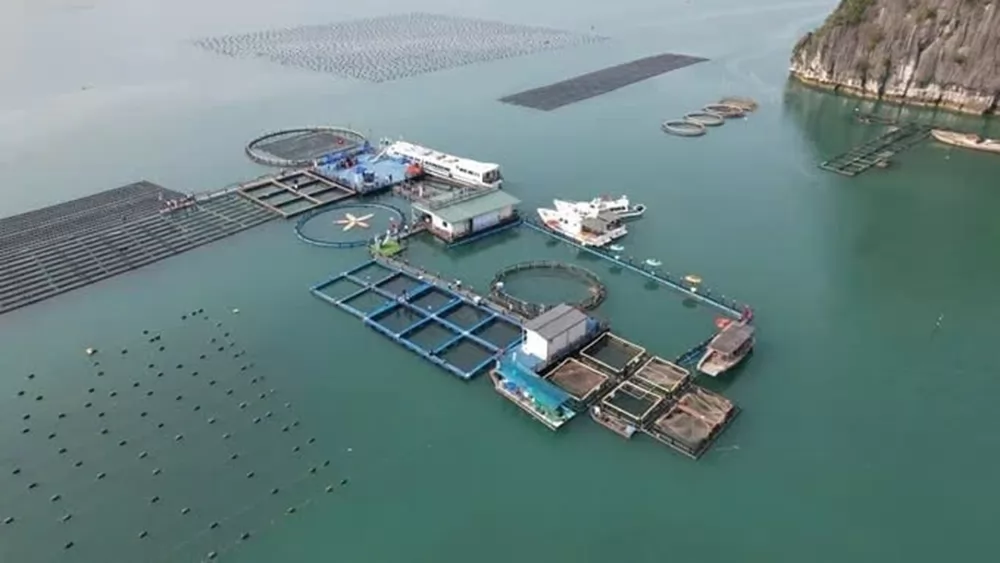
The system decentralizes authority down to commune-level governments, with applications generated at any level to be entered, managed, monitored, and supervised by that same level. Photo: Cuong Vu.
(VAN) The Information System for the Exploitation and Utilization of Marine Resources has officially come into operation, enabling data connectivity and supporting unified management from the central to local levels.
Since its nationwide launch in late March 2026, the Information System for the Exploitation and Utilization of Marine Resources has made a clear mark on the digital transformation process in the marine and island sector. The system is an important data platform that directly supports the allocation of sea areas, thereby improving the effectiveness of state management.
Synchronizing data, accelerating management
According to the Viet Nam Agency of Seas and Islands (VASI), the system has been uniformly deployed across all 21 coastal provinces and cities, with data updated, cleaned, and synchronized to the National Data Center. The completion of the database under the "correct, sufficient, clean, live" criteria helps ensure accuracy, transparency, and long-term usability.
A key highlight of the system is the integration of 54 reference data layers, comprehensively covering all elements related to marine spatial areas. These data layers are organized into groups, including national marine spatial planning, coastal zone planning, marine dumping planning, sectoral planning, administrative base data, marine topography, boundary lines, and, notably, data on allocated sea areas. As a result, users can access information in a visual, synchronized, and systematic manner.
Beyond data storage, the system also provides multidimensional statistical and analytical tools. Reports are flexibly designed at provincial and national levels, clearly reflecting the implementation of sea area allocation. From the number of applications and allocated areas to geographic distribution (within 3, 6, 12, and 15 nautical miles) and usage-purpose structures, all information is presented through visual charts, helping management agencies easily monitor, compare, and make decisions.
Notably, the system also allows comparisons among localities, even down to commune and ward levels, thereby enhancing transparency and creating a basis for assessing the effectiveness of marine resource management and utilization in each locality.
Another new feature is the system’s ability to interconnect with national databases and public service systems. Data related to sea area allocation applications are updated in real time, ensuring “live” data while minimizing deviation and duplication.
The system has also been decentralized to the commune level, enabling local authorities to proactively input, manage, and monitor arising applications. This approach not only shortens processing time but also strengthens accountability at every level of government.
In terms of security, the system meets level-3 information security standards and applies OTP-based user authentication. At the same time, a mobile application version has been launched, allowing management officials to access information promptly and flexibly.
Practical operation, initial effectiveness
After a short period of operation, the system has recorded initial positive results. As of March 31, 2026, more than 300 accounts had been granted down to the commune level and were in regular operation. A total of 1,364 applications had been updated, including 256 organizations and 938 individuals applying for sea area allocation, all of whom had their information verified through tax identification numbers and citizen identity cards.
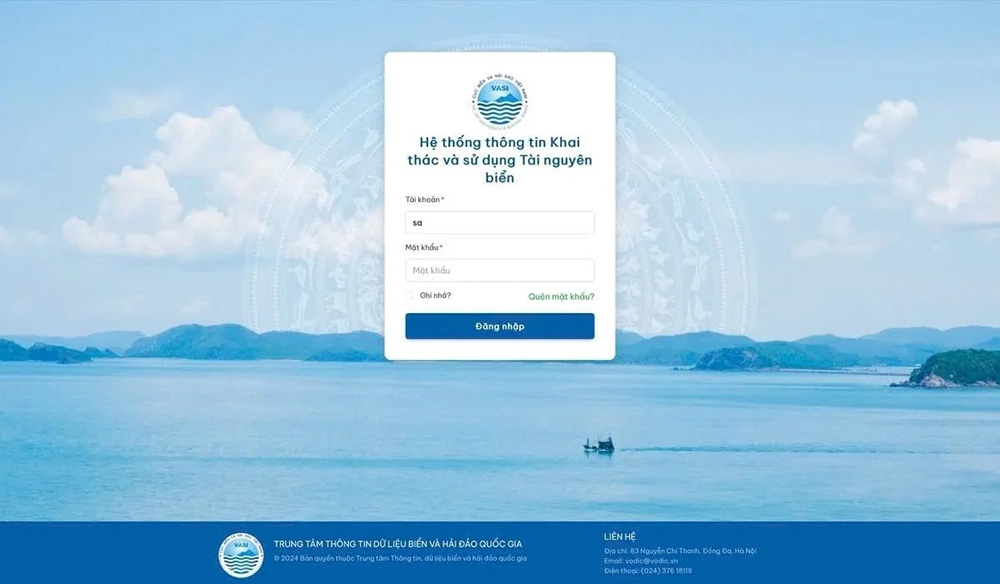
The Information System for the Exploitation and Utilization of Marine Resources is operating at https://giaobien.vasi.gov.vn/. Photo: Truong Giang.
Mr. Vo Xuan Hung, Director of the Viet Nam Ocean Data and Information Center under the Viet Nam Agency of Seas and Islands, the unit directly responsible for managing and operating the system, said that in the coming period, direct training sessions will continue to be organized in localities, while the system’s functions will be further improved in line with practical demands. Infrastructure upgrades, enhanced cybersecurity, and data standardization will also be accelerated to meet the requirements of large-scale data processing.
In particular, the system will be more deeply integrated with the National Public Service Portal, ensuring that the entire process from application receipt to processing is carried out in a digital environment so that data remain continuously updated and "live." In addition, existing application data will continue to be standardized and cleaned, while new data will be regularly updated.
The operation of the Information System for the Exploitation and Utilization of Marine Resources is not only a technological advancement but also a sign that marine resource management is shifting strongly toward a more digital, transparent, and efficient approach, meeting sustainable development requirements in the new phase.
In the context of increasingly high demands for sustainable development, marine resource management based on digital data will become an inevitable trend. This system represents an important initial step toward realizing the goal of building modern, transparent, and effective marine governance.
The Information System for the Exploitation and Utilization of Marine Resources is being uniformly deployed and shared nationwide, featuring 54 reference data layers under groups including National Marine Spatial Planning; National Coastal Zone Planning; Marine Dumping Planning; Sectoral and Field Planning; Administrative and Marine Topographic Base Data; Maritime Boundary Lines; and Allocated Sea Areas.
Author: Giang Dang
Translated by Thu Huyen
Maybe you are interested
Ninh Thuận farmers expand aquaculture
The province has great potential for developing marine aquaculture as it has a coastline of more than 100km, and clean sea water with high and consistent salinity.
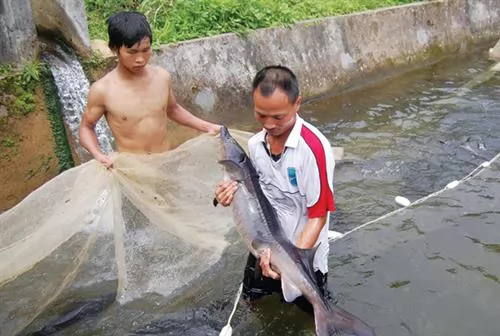
Caged-sturgeon breeding brings high incomes to mountainous farmers
LÀO CAI — Breeding cold-water sturgeon in cages has brought a stable source of income for poor farmers in the northern mountainous province of Lào Cai.


ASF Philippines: How traders influence pork prices amid outbreaks
As the fight against ASF continues, pig traders in the Philippines are putting salt in the wound. They are driving down farm gate prices by spreading misinformation about the severity of ASF.