HCM City to switch from pork production to pig breeding
Update: Apr 03, 2021 - 14:06 (GMT+7)


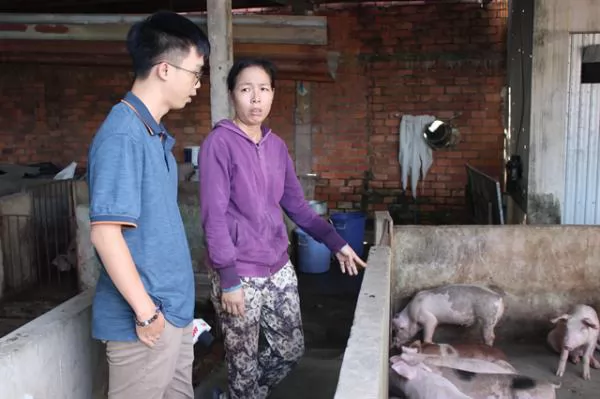
A pig farming household in HCM City's Củ Chi District. - VNA/VNS Photo Xuân Anh
HCM CITY — HCM City plans to move its pig farming industry away from breeding for pork and increase the number of pigs raised for breeding purposes in the next five years.
It will develop nuclear farms for producing high-quality piglets for supply to farmers in the city and elsewhere.
It will seek to expand household pig farms into large–scale farms that breed operate on an industrial scale, use high–tech breeding techniques to ensure safety and achieve Vietnamese good agricultural practices (VietGAP) standards.
It has 2,280 pig farming establishments with more than 200,000 head.
It plans to sustain this size until 2025.
Most of the farms are in the five outlying districts of Củ Chi, Hóc Môn, Bình Chánh, Cần Giờ, and Nhà Bè.
The number of farms that do not comply with safety standards, especially those that feed their animals food residues, will be reduced this year.
The city targets 60 – 70 per cent of households farming pigs to VietGAP standards this year and 90 – 95 per cent by 2025 and 90 – 100 per cent of them meeting environmental protection regulations this year and 100 per cent by 2025.
A digital map for managing pigs and pig diseases will be ready by this year.
The city wants more than 10 per cent of farming households to be members of co-operative groups or co-operatives this year and 20 per cent in 2025.
To meet the five-year targets it will encourage farming households to invest in farms with closed processes, adopt advanced breeding techniques and raise pigs either for meat or producing piglets and not both.
It will implement bio-safety measures for disease prevention to develop farms that are safe from outbreaks and ensure the use of pig feed with clear origins.
The pig farming districts in co-operation with relevant departments and agencies will support the development of pig co-operative groups and co-operatives and linkages among stakeholders to increase the incomes of farming households.
The Department of Industry and Trade will establish a pork trading floor.
An average of 10,000 pigs are traded daily in the city.
There are 24 pig slaughterhouses.
Nguyễn Ngọc Hòa, chairman of the HCM City Finance and Investment State Owned Company and a member of the steering committee for setting up the trading floor, said it would help pig farmers directly access consumers and provide clear information to all stakeholders.
The floor would also meet the demand for modernising pig farming and hygienic and safe meat, stabilise pork prices and develop exports via official channels, he added. – VNS
Maybe you are interested
Tra fish sector aiming for production, processing greening for sustainable development
Greening production and processing to meet export requirements is both a trend and a necessity for many industries, including the tra fish sector.
Small farmers in Europe struggle to get by
Brutal economic situation has inflicted misery on farmers who struggle to turn a profit and forced some to look for alternative streams of revenue.
Bac Kan basically has African swine fever under control
After a period of intense outbreaks, the situation of African swine fever in Bac Kan has gradually settled down. Livestock farmers begin to restock the herd.