Tiền Giang Province develops fresh water aquaculture
Update: Jan 20, 2023 - 13:37 (GMT+7)


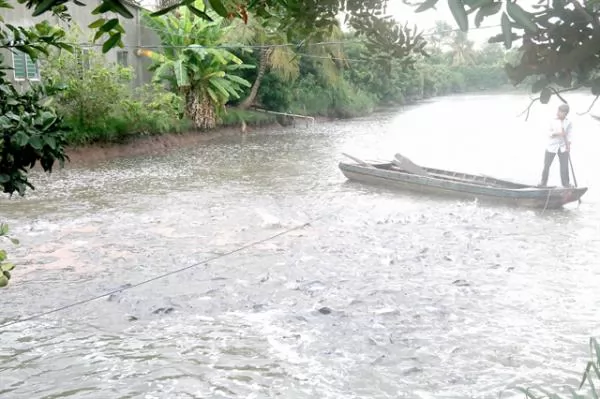
Tra fish is bred under intensive farming in Tiền Giang Province's Cái Bè District. - VNA/VNS Photo Minh Trí
The Cửu Long (Mekong) Delta province of Tiền Giang is expanding fresh water aquaculture in upstream localities of the Tiền River.
TIỀN GIANG – The Cửu Long (Mekong) Delta province of Tiền Giang is expanding fresh water aquaculture in upstream localities of the Tiền River.
Cai Lậy, Cái Bè and Tân Phước districts and the town of Cai Lậy have bred more than 3,200ha of freshwater fish such as tra fish, snakehead fish, climbing perch, carps, bighead catfish and tilapia so far this year, according to the provincial Department of Agriculture and Rural Development.
The upstream localities also have hundreds of floating cages for breeding fish in the Tiền River, a tributary of the Mekong River.
The floating cages breed mostly red tilapia, bighead catfish and tra fish.
The breeding of freshwater fish has offered high production efficiency for farmers and helped restore freshwater aquatic resources in the delta, according to the department.
To increase the efficiency of freshwater aquaculture and improve income for farmers, the department, in co-operation with localities, is teaching farmers techniques of breeding fish and reproducing fish seeds.
The department is also introducing and expanding effective freshwater aquaculture models to farmers.
It is also upgrading irrigation works to create favourable conditions for freshwater aquaculture development.
Localities have developed concentrated aquaculture areas for producing seeds of freshwater fish species, which are sold to farmers in the province and the southern region.
Cai Lậy, for instance, has established a concentrated aquaculture area for producing seeds of freshwater fish species in Tân Hội Commune.
Concentrated aquaculture areas for producing seeds of ornamental fish species have also been developed in Cai Lậy’s Mỹ Thành Nam, Mỹ Thành Bắc communes, and Cái Bè District’s Mỹ Hội Commune and Hậu Mỹ Bắc A Commune.
Nguyễn Văn Trước in Hậu Mỹ Bắc A Commune has 30ha for producing seeds of tra fish, carps and ornamental fish species.
He produces about 25-30 tonnes of fish seeds a year and earns billions of đồng a year, he said.
Hậu Mỹ Bắc A has hundreds of hectares of aquaculture area devoted to producing fish seeds, making it the province’s largest freshwater fish seed producer.
The production of freshwater aquaculture in the Tiền River’s upstream localities has offered a profit many times higher than growing rice and is suitable for farmers who have small farmland, according to the department.
It has also adapted to climate changes and flooding situations in the upstream localities, helping many farmers escape poverty and have stable lives, said the department.
The province has encouraged farmers to breed aquatic species to good agricultural practices (GAP) standards to meet the requirements of domestic and export markets. – VNS
Maybe you are interested
Localities put on alert for livestock diseases
HÀ NỘI — Prime Minister Nguyễn Xuân Phúc has called on ministries, Government agencies and local authorities nationwide to roll out precautionary measures to stop poultry and cattle diseases.
Hà Nội's farm economy yields high economic value
In recent years, Hà Nội's agriculture sector has created favourable conditions for organisations and individuals to develop the farm economy.
Strengthen inspection and supervision in livestock production
Through inspections and monitoring of banned substances in the Beta-agonist group (Salbutamol) in Hau Giang province, all samples appeared negative.