Tuna exports rise despite challenges in US market
Update: Mar 07, 2026 - 14:03 (GMT+7)


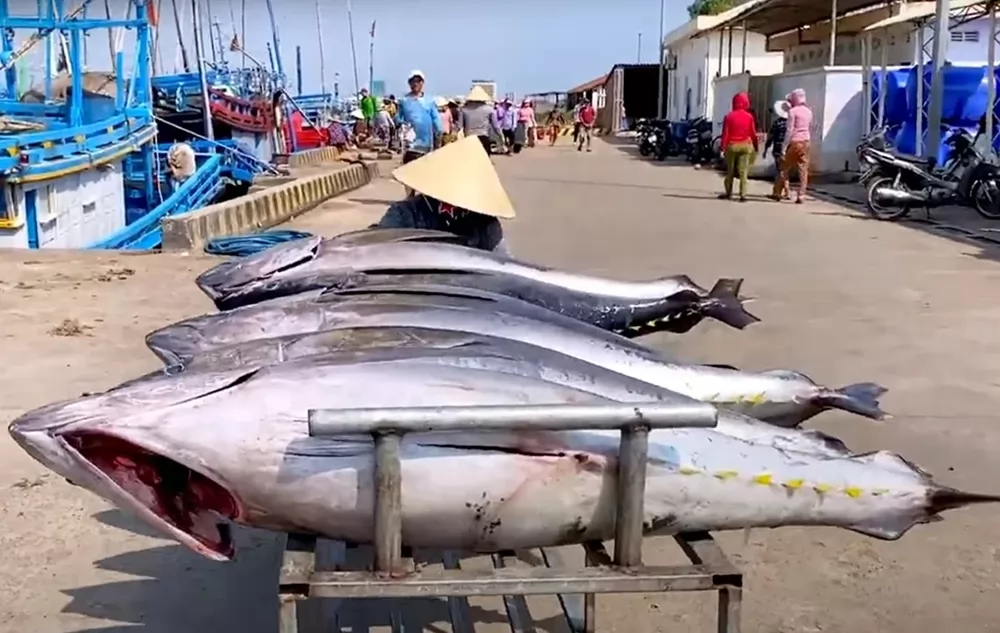
Bringing tuna ashore at Dong Tac port, former Phu Yen province. Photo: Son Trang.
(VAN) Despite mounting difficulties in its largest market, the United States, Vietnam’s tuna exports still recorded solid growth in the first month of the year, driven by stronger demand from other markets.
In contrast to 2025, tuna exports at the beginning of 2026 are showing positive signs.
According to data from Viet Nam General Customs, tuna export turnover in January 2026 exceeded USD75 million, up 13% year-on-year. The figure marks a positive start for Viet Nam’s tuna industry after a year of contraction, when exports in 2025 reached USD 924 million, down 7% from 2024.
The United States remained the largest market for Vietnamese tuna. Exports to the U.S. reached USD24 million in January, accounting for 32% of total tuna export value, but declined 6% compared with the same period in 2025.
The drop is linked to compliance risks related to the Marine Mammal Protection Act (MMPA), which took effect on January 1, 2026. Under the regulation, seafood products from fisheries deemed to have “no comparable regulatory program” will be banned from entering the U.S. market.
Products not directly banned but sharing the same country of origin and HTS code with restricted items must submit a Certificate of Admissibility (COA) to prove they are not subject to the prohibition. As a result, exporters face stricter documentation requirements and increased inspections, potentially leading to higher costs and shipment delays, particularly during the early stages of implementation.
At the same time, changes in U.S. import tariff policies are also affecting tuna imports.
In February 2026, international media reported that the United States had entered a phase of adjusting its “reciprocal or additional tariff” mechanism, following a ruling by the U.S. Supreme Court and a shift to a temporary tariff framework under Section 122 of the Trade Act of 1974, which was in effect for 150 days.
Some sources also noted that the general tariff rate could be raised at the executive's discretion. Final tariff levels applied to specific tuna products under different HS codes, as well as those imposed on Viet Nam, will depend on official announcements and product-line classification.
While exports to the U.S. declined, shipments to most other key markets, including Japan, the European Union, and Russia, posted strong growth, with several markets recording sharp increases.
In January, tuna exports to Japan surged 95%, while exports to Germany rose 39% and the Netherlands increased 15%. Some markets expanded rapidly from a low base, including Egypt (up 129%) and Chile (up 133%).
According to the Viet Nam Association of Seafood Exporters and Producers (VASEP), the export performance in the first month of the year shows that Vietnamese companies are increasingly diversifying their export markets.
This trend is reflected in rising shipments to major market blocs, including the EU, up 25%, CPTPP members, up 53%, and the Middle East, up 35%.
Author: Son Trang
Translated by Linh Linh
Maybe you are interested


An Giang: Tire track eel incubated by probiotic technology
An Giang farmers has successfully deployed the breeding and applied microbial technology in incubating tire track eel for environment assurance.
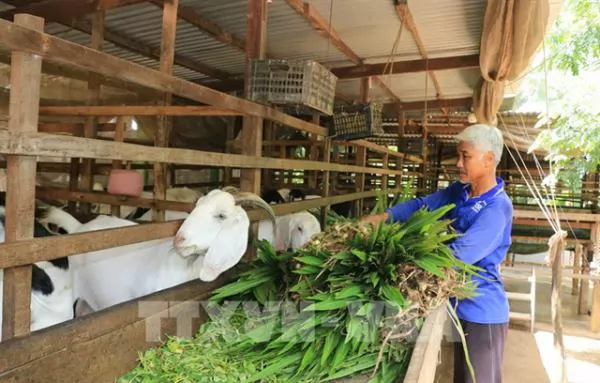

Goats pull Đồng Tháp Province farmers out of poverty
Breeding goats has helped many farmers in the Cửu Long (Mekong) Delta province of Đồng Tháp escape poverty and earn a steady income since the animal is easy and inexpensive to raise.


Farmers in southwest France express growing concern over the ongoing heatwave
Orchardists, winegrowers and livestock farmers fear the negative impact of the current heatwave on their production.