Viet Nam's livestock breakthrough: Turning technical edges into restructuring success
Update: Mar 21, 2026 - 13:06 (GMT+7)


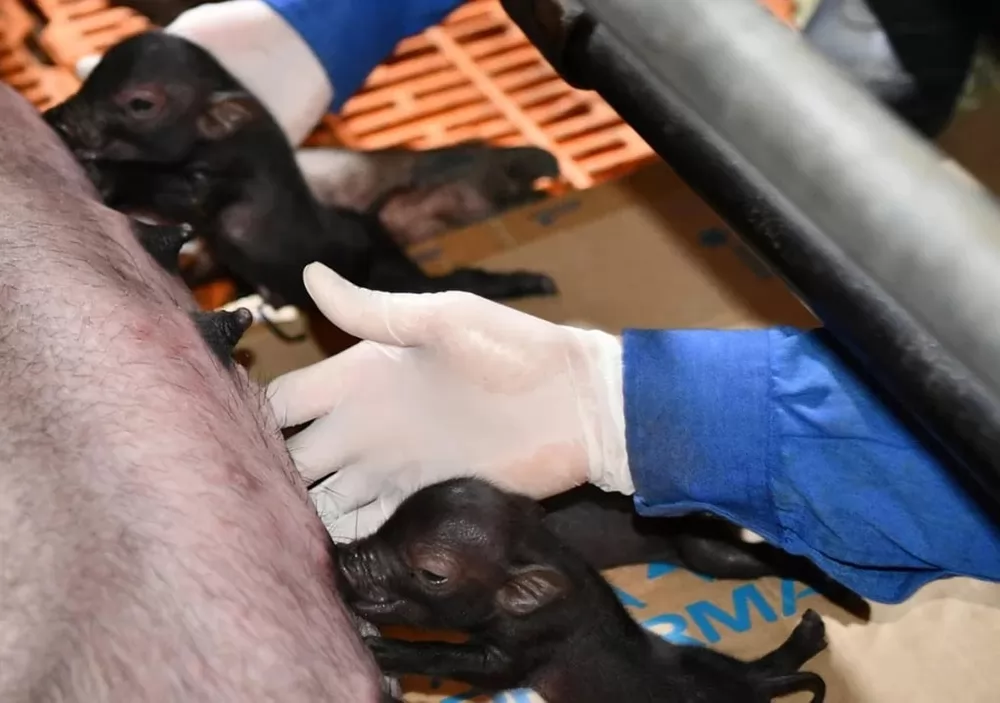
Successful cloning of an indigenous pig breed from somatic cells derived from ear tissue. Photo: Van Giang.
(VAN) For many years, when discussing genetic improvement, the livestock sector has often emphasized productivity. However, at the current stage of development, the story no longer stops there.
According to Dr. Nguyen Van Trong, former Deputy Director General of the Department of Livestock Production and Vice President of the Vietnam Farms and Agricultural Enterprises Association, the core issue now is not whether good breeds are available, but how the breeding system is organized to generate real efficiency for the entire sector.
The challenge of livestock breeding is therefore shifting from technical aspects to structural ones, from individual breeds to the overall breeding production system.

Dr. Nguyen Van Trong, former Deputy Director General of the Department of Livestock Production and Vice President of the Vietnam Farms and Agricultural Enterprises Association. Photo: Bao Thang.
Viet Nam doesn't lack good breeds
“Viet Nam does not lack good breeds,” said Mr. Nguyen Van Trong, noting that over the past decades, the livestock sector has made significant advances in genetics. Many livestock breeds have increased productivity by 20-30% while reducing feed consumption by around 25%. Some poultry breeds have reached productivity levels among the highest in the world.
Notably, most high-yield global breeds are already present in Viet Nam. Domestic enterprises have also quickly adopted scientific advances, developed several new breeds, and conserved indigenous genetic resources.
However, according to Mr. Trong, the current issue does not lie in a shortage of good breeds, but in how breeding production is organized. A persistent, systemic problem is fragmentation. When everyone produces breeding stock independently, it leads to weak linkages, poor quality control, and the inability to fully exploit hybrid vigor.
This bottleneck runs counter to modern breeding systems, which are typically structured as a pyramid. At the top is the nucleus herd, strictly controlled for genetics. The middle tier consists of grandparent and parent stock. The bottom tier is commercial livestock. Only by operating within this structure can genetic advantages be consistently maintained and disseminated to large-scale production. Otherwise, even high-quality breeds may gradually be “eroded” over generations. This is the fundamental difference between industrial livestock production and small-scale, fragmented farming.
Viet Nam has made important institutional advancements to support the development of breeding technologies. The 2018 Law on Livestock Production, along with related decrees, circulars, and the development strategy toward 2030 with a vision to 2045, has established a legal framework for breed development, recognizing it as one of the key pillars of the sector.
However, institutions are only a necessary condition. The remaining challenge lies in implementation. According to Mr. Trong, the domestic livestock sector cannot fully transition to large-scale farming while millions of smallholder households still exist. Therefore, the issue is not replacement, but restructuring production in a more sustainable way. In this context, commercial farms will play a leading role, while smallholder farming must be professionalized, ensuring biosecurity, integrating into value chains, and gaining access to quality breeding stock.
This creates a dual requirement for the breeding system: it must both support large-scale industrial production and meet the localized needs of smallholders. In other words, breeding is not merely a technical matter, but a question of how the entire sector is organized.
Breeding in a competitive era
Dr. Nguyen Van Trong emphasized that while the primary goal of breeding in the past was to increase productivity, this objective has now shifted amid growing competitive pressures. Viet Nam is not only competing in export markets but also in the domestic market, which is substantial, with a population of 100 million and hundreds of millions of tourist arrivals each year.
In this context, breeding must serve a clear objective: reducing production costs. Currently, feed accounts for 65-70% of livestock production costs, while most feed ingredients are imported. If breeds do not improve feed efficiency or shorten production cycles, achieving competitiveness will be difficult.
“Losing on the home ground is a real risk,” Mr. Trong noted, acknowledging that this is a time for a shift in mindset. Breeds should no longer be evaluated solely on productivity but on overall economic efficiency, alongside requirements for quality and market segmentation.
According to Mr. Trong, Viet Nam is developing livestock breeds across three distinct segments: high-productivity breeds, mostly imported, serving industrial production; crossbred lines that balance productivity and quality; and indigenous breeds targeting niche, high-value specialty markets. This approach reflects the reality that no single breed fits all purposes. Identifying the right segment helps avoid mismatches between production and market demand.
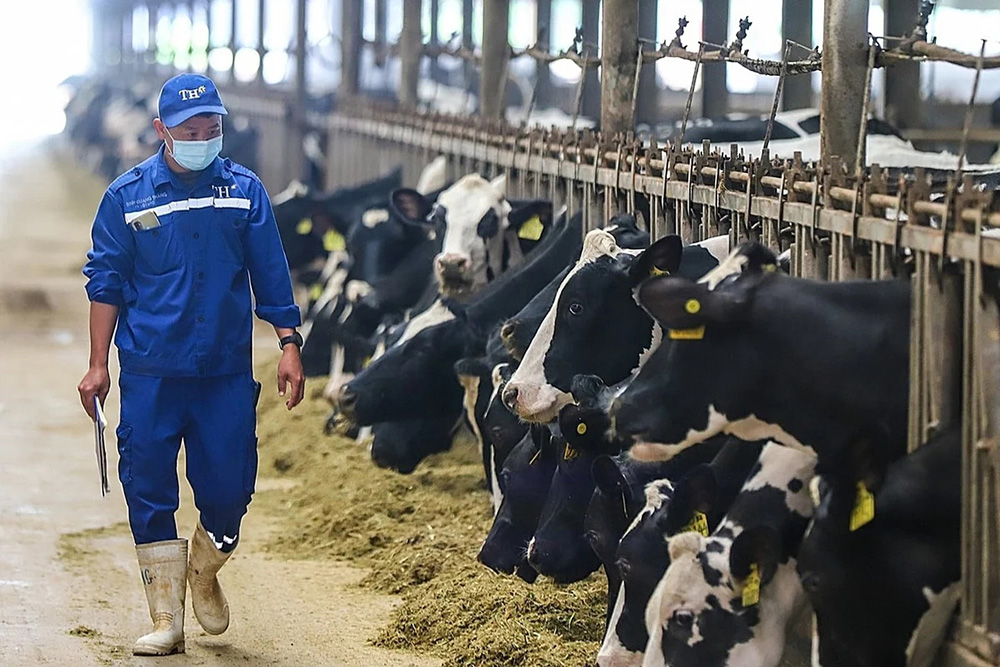
Thanks to continuous genetic improvement, Viet Nam has developed a high-quality dairy cattle herd, gradually replacing imported sources. Photo: TH.
Another emerging trend is the application of biotechnology in breeding. In the past, breeding mainly relied on traditional methods. Today, gene technology, genetic data, and genomic selection are gradually becoming key tools. Genome sequencing enables the precise identification of desirable traits such as rapid growth, low feed consumption, and strong resilience.
In the future, gene-editing technologies may create livestock breeds that are better adapted to climate change and disease. This will undoubtedly mark a qualitative leap in livestock science.
However, the challenge lies not in having the technology, but in how quickly it can be applied in practice. Politburo Resolution 57 on science and technology development and innovation is seen as a guiding framework, but its ultimate effectiveness depends on commercialization capacity and production organization. At the same time, clear targets have been set for breeding self-sufficiency: around 80% for pigs and poultry, 70% for cattle, and 100% for waterfowl.
Significant achievements have been made. Good breeds are already available, technologies are in place, and the market is expanding. The remaining challenge is to organize the breeding system along modern lines, strengthen linkages among breeding facilities, clearly segment markets, and restructure the relationship between commercial farms and smallholders.
If this is achieved, genetic progress will not remain confined to laboratories or a few large enterprises, but will spread across the entire sector. At that point, breeding will no longer be just a technical factor but will become a true source of competitiveness for Viet Nam’s livestock industry.
Self-sufficiency is not only about meeting domestic demand but also about targeting export markets. However, to achieve this, two key conditions, cost competitiveness and food safety with traceability, must be ensured. This brings us back to the starting point: breeding must be embedded within an efficient, well-controlled, and transparent production system.
From March 27-28, the Ministry of Agriculture and Environment will host the first National Conference on Livestock and Veterinary Science and Technology, with the participation of leaders from National Assembly agencies, the Government Office, relevant ministries and sectors; management agencies, associations and unions, businesses, and scientists in the livestock and veterinary fields nationwide. The conference will take place at the National Convention Center on Pham Hung Street, Tu Liem Ward, Ha Noi.
The Vietnam Agriculture and Nature Newspaper will provide live coverage of this important event.
Author: Bao Thang
Translated by Phuong Linh
Maybe you are interested
Tuna enterprises struggling to find a way out
Facing barriers from major markets such as the US and the EU, Vietnam's tuna enterprises are striving to find new markets.


Hanoi to turn fisheries into important sector
Hanoi plans to develop fisheries into an important economic sector with large scale, high value and good brand, meeting local demand for freshwater aquatic products and export standards.
Russia to ban free-range poultry
'The new rules prohibiting free range make organic production impossible,' the Union said.