Viet Nam to reduce methane emissions in livestock production
Update: Dec 28, 2025 - 13:09 (GMT+7)


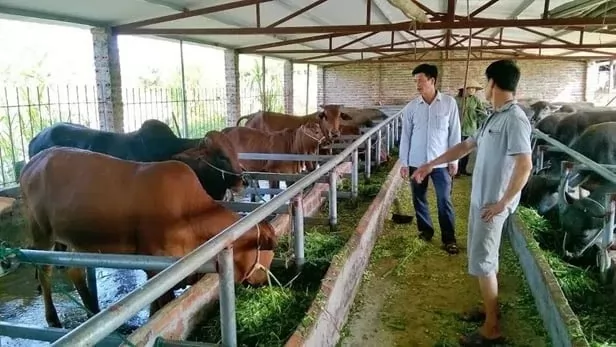
The two main emission sources are enteric fermentation in ruminant animals and the management and treatment of livestock waste. Photo: Khanh Ly.
(VAN) As Viet Nam makes strong commitments toward achieving net-zero emissions, controlling and reducing methane emissions in livestock production is increasingly becoming a mandatory requirement.
Rising emission pressure
According to Dr. Le Thi Thanh Huyen, Head of the Department of Livestock Systems and Environment Research under the National Institute of Animal Science (NIAS), Ministry of Agriculture and Environment, it is estimated that during the 1994–2020 period, greenhouse gas emissions from livestock production rose from under 10 million tons of CO₂e to nearly 19 million tons of CO₂e. Of this total, methane accounts for the largest share, originating from two main sources: enteric fermentation in ruminants and the management and treatment of livestock waste.
Inventory data show that, of total methane emissions from the livestock sector, enteric fermentation accounts for about 74%, while the remaining 26% comes from manure management. For rumen fermentation alone, cows contribute nearly two-thirds of emissions, followed by buffaloes, goats, sheep, and other species.
Each year, Viet Nam's livestock sector generates approximately 62 million tons of solid waste and more than 300 million tons of liquid waste. If not properly treated, this waste volume not only causes environmental pollution but also represents a significant source of methane emissions.
Under the National Climate Change Strategy to 2050, agriculture has been identified as one of the sectors required to achieve substantial emission reductions. For methane in particular, Viet Nam has committed to cutting emissions from agriculture by 30% by 2030 compared to 2020 and by 40% by 2050 compared to 2030.
To realize these targets, a Measurement, Reporting, and Verification (MRV) system has been established. From 2025 onward, large-scale livestock facilities will be required to conduct greenhouse gas inventories and report in accordance with unified technical standards.
Reducing methane through improved nutrition and waste management
Research by NIAS indicates that the potential for reducing methane emissions in livestock production is entirely feasible if scientific and technical solutions are applied synchronously.
In terms of improving animal diets, for ruminants, the use of silage, along with supplements that inhibit methanogenesis, such as 3NOP, activated carbon, zeolite, or tannin-rich feeds, can significantly reduce methane emissions from the rumen while improving feed-use efficiency. The application of ration formulation software helps balance nutrition and reduce emissions per unit of product.
Regarding waste management solutions, biogas digesters enable the capture of methane for energy production, simultaneously reducing emissions and providing electricity and heat for farming households. In addition, composting technologies, solid–liquid separation, and the application of microbial products not only cut greenhouse gas emissions but also produce high-quality organic fertilizers, supporting circular livestock production and green agriculture.

Biological bedding solutions help reduce methane emissions from livestock waste. Photo: Duong Tuong.
One example is the use of biological bedding in cow farming barns. Thanks to a dry and clean barn environment, cows experience fewer hoof and foot diseases, achieve better weight gain, and require less water for cleaning, while odors are reduced. After use, the bedding can be sold as fertilizer, generating additional income for farmers.
As emission reduction requirements become increasingly explicit, Viet Nam's livestock sector stands at a critical crossroads. By effectively leveraging scientific and technological advances, livestock production can not only reduce methane emissions but also enhance economic efficiency, moving toward a green, circular, and sustainable agriculture.
Authors: Khanh Ly - Duong Tuong
Translated by Thu Huyen
Maybe you are interested
Soc Trang's commune advances towards model new-style rural area
Dai Tam commune in My Xuyen district is one of the highlights in a new rural building in the Mekong Delta province of Soc Trang.
Booming pork demand sparks race among Vietnam's top pig producers
With pork prices high, Vietnamese producers like BaF and Dabaco are scaling up against foreign rivals.
Delta farmers reap high profits from breeding giant river prawn
Viet Nam News | HCM CITY — Farmers in the Mekong Delta have had a bumper harvest of giant river prawns at good prices because of favourable weather conditions and high market demand.