Vietnam considers multi-storey pig farming to modernise livestock industry
Update: Jun 13, 2026 - 15:21 (GMT+7)


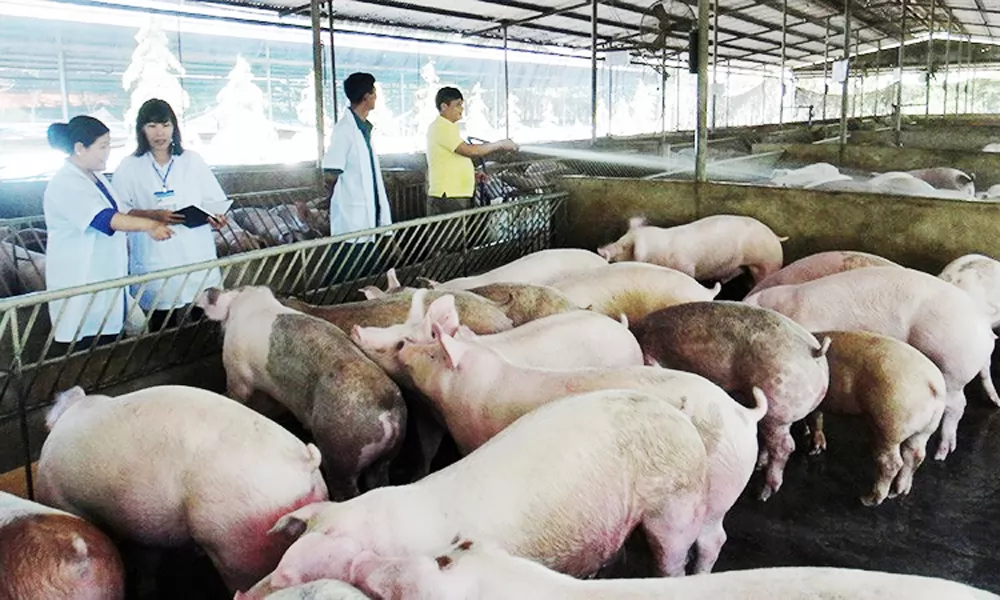
Illustrative image.
Multi-storey pig farming offers several advantages over traditional models as it leverages scientific and technological advances such as AI, blockchain, ICT, and automation for smart farming systems to support early disease detection, real-time weight estimation, and cost optimisation.
Deputy Minister of Agriculture and Environment Phung Duc Tien has submitted a proposal to the Prime Minister seeking approval to implement a multi-storey pig farming model in Vietnam.
According to the Ministry of Agriculture and Environment (MAE), two companies, BAF Vietnam JSC and Xuan Thien Thanh Hoa JSC, have submitted official documents requesting guidance on launching multi-storey pig farms.
BAF Vietnam has set up a strategic partnership with Muyuan Foodstuff Group of China, the world’s largest pig farming enterprise renowned for its high-rise, large-scale pig farming operations.
This company has proposed a smart 6-storey pig farming complex in Tay Ninh province. The project would raise 64,000 breeding sows and produce up to 1.6 million commercial pigs per year, with a total investment estimated at over 12 trillion VND (475 million USD).
Once fully operational, the project is expected to generate 12–13 trillion VND in annual revenue, with a projected payback period of 5 to 5.5 years.
The MAE noted that China began developing multi-storey pig farms in 2018 and now has over 2,000 such facilities, including nearly 4,500 high-rise pig farm buildings. These supply around 2.65 million breeding sows and over 30 million market hogs annually.
Multi-storey pig farming offers several advantages over traditional models as it leverages scientific and technological advances such as AI, blockchain, ICT, and automation for smart farming systems to support early disease detection, real-time weight estimation, and cost optimisation.
Biosafety and disease control are also significantly improved through advanced systems for water, waste, and gas treatment, which reduce emissions, save water, and generate organic fertiliser for agriculture.
Air quality is managed via a four-layer filtration system that eliminates over 95% of odour, disinfects emissions, and prevents disease outbreaks from external sources. This model also saves land and infrastructure costs while requiring fewer workers since one person can oversee up to 2,000 pigs.
Vietnam’s Law on Animal Husbandry encourages the application of high-tech and modern farming methods to enhance productivity, quality, biosafety, and environmental protection.
In 2024, the country issued a national standard for multi-storey pig farms, detailing regulations on farm scale, processes, and infrastructure.
Moreover, the strategy for animal farming development 2021–2030, with a vision to 2045, sets the goal of modernising the livestock sector, boosting productivity and competitiveness while ensuring biosafety and environmental sustainability.
Pig farming is Vietnam’s key livestock industry, accounting for 62–65% of total live meat output. In 2024, the country produced nearly 5.2 million tonnes of live pigs, ranking 6th globally.
By VNA
Maybe you are interested
Livestock industry must make haste on transformation
A report by the Department of Livestock Production and Animal Health says over 30 per cent of domestic livestock output still from small-scale, scattered farms not connected to value chains.
Livestock industry suffering due to poultry smuggling
The amount of live chickens imported illegally across the border has increased to 200,000 - 250,000 tonnes each year


This 525-pound bluefin tuna just sold for nearly $800,000 at Tokyo's new year'saAuction
It's the highest price paid for a fish at the annual sale since the pandemic began.